
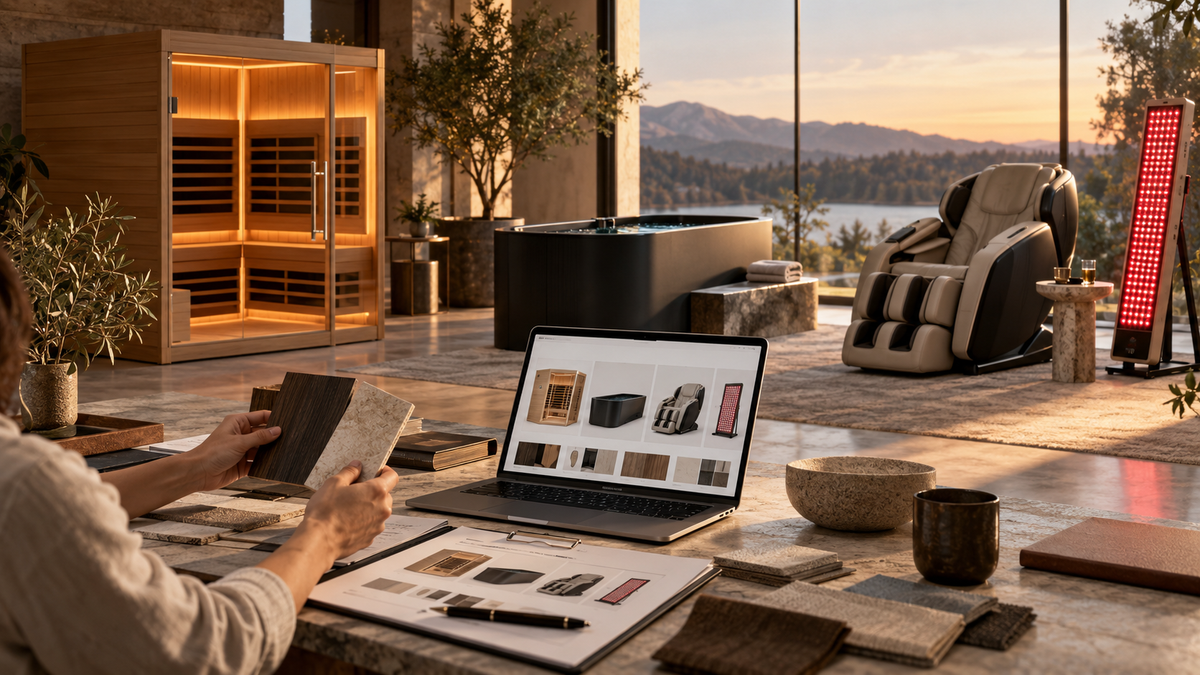
Recovery equipment is expensive, technical, and increasingly crowded with products that look impressive on a product page but are much harder to evaluate in the real world. Our goal at Recovery Legacy is not to list every sauna, cold plunge, massage chair, red light device, or oxygen-therapy product we can get access to. It is to narrow the field.
That means doing more of the filtering before a product ever reaches the storefront: reading specifications, comparing similar models, looking at installation requirements, reviewing warranty and support information, separating meaningful features from marketing language, and asking whether a product actually belongs in a high-ticket recovery catalog.
In short: we would rather offer a smaller catalog we understand than an enormous catalog we cannot defend.
Why curation matters more with high-ticket recovery equipment
Buying a $40 accessory and buying a multi-thousand-dollar sauna, cold plunge, massage chair, or recovery system are completely different decisions. With high-ticket equipment, the consequences of a poor purchase are larger: installation may be involved, freight delivery matters, replacement parts matter, warranty service matters, and a feature that sounded exciting online may not matter nearly as much as electrical requirements, dimensions, build quality, or long-term support.
That is why we do not think the right shopping experience is an endless wall of products with nearly identical descriptions. More choice is not always better choice.
Our approach is to ask a different question:
If we were helping someone make this purchase one-on-one, what would we want to know before recommending that they spend the money?
1. We start with the actual use case
Before evaluating features, we look at what a product is supposed to do and who it is realistically for.
A two-person infrared sauna for an indoor home gym is solving a different problem than a six-person outdoor traditional sauna. A compact cold plunge with integrated filtration is different from a larger commercial-style system. A wearable red light device is not interchangeable with a full-body panel.
We want the product's design, size, heating or cooling method, controls, installation requirements, and price to make sense for the customer it is intended to serve.
If the use case is unclear—or the product seems to exist mainly because a supplier wants another SKU in the market—that is a reason for us to look harder before adding it.
2. We look for technical transparency
Good high-ticket equipment should come with useful specifications.
Depending on the category, that can include:
- Dimensions and stated capacity
- Electrical requirements
- Heater output or cooling capacity
- Materials and construction
- Temperature ranges
- Filtration and sanitation systems
- Infrared wavelengths or heater configuration
- EMF measurements and the distance at which they were taken
- Massage mechanism and track design
- Pressure specifications for oxygen-therapy equipment
- Warranty terms and covered components
We prefer products where the important details can be clearly explained instead of hidden behind vague phrases such as “advanced technology,” “medical grade,” or “professional performance” without enough information to understand what those claims actually mean.
3. We separate meaningful features from feature inflation
High-ticket wellness products can become feature-heavy very quickly. Bluetooth, lighting systems, touchscreens, apps, preset programs, voice controls, extra modes, and other additions can be useful—but they are not automatically what makes the equipment good.
We try to distinguish between core performance and nice-to-have features.
For example, with a sauna, heater type, electrical requirements, materials, cabin dimensions, heat distribution, and installation may matter more than the number of entertainment features. With a cold plunge, cooling performance, filtration, sanitation, insulation, and serviceability may matter more than how impressive the control panel looks.
Features should support the equipment, not distract from weak fundamentals.
4. We look at the ownership experience, not just the product page
A product can look excellent before the sale and become frustrating afterward. That is why we also care about what happens once the equipment reaches the customer.
We look at factors such as:
- How the product is delivered
- Whether assembly or professional installation may be required
- Whether the electrical or space requirements are realistic
- How replacement parts are handled
- What the warranty actually covers
- How technical support is provided
- Whether the manufacturer provides usable documentation
For equipment that may remain in a home for years, after-sale support is part of the product.
5. We evaluate the manufacturer as well as the machine
Recovery Legacy works with manufacturers and suppliers, so the quality of that relationship matters too.
We pay attention to whether a company can answer technical questions, provide clear specifications, explain its warranty process, supply current product materials, and support the customer after the sale.
A beautiful piece of equipment becomes much less attractive if basic questions are difficult to answer or support disappears once an order is placed.
This does not mean every manufacturer has to operate the same way. It means we want enough transparency and support to feel comfortable putting the product in front of a customer.
6. We are cautious with health and performance claims
Recovery equipment is often marketed with strong claims about health, recovery, performance, pain, circulation, detoxification, sleep, inflammation, and other outcomes.
We try to separate three things:
- What the equipment physically does
- What a manufacturer claims
- What research actually supports
Those are not always the same thing.
We would rather explain a product conservatively than turn an interesting technology into a promise it cannot support. When health-related evidence is relevant, our Recovery Library is designed to distinguish research from marketing and explain where the evidence is stronger, weaker, or still developing.
7. We compare products against each other, not in isolation
A product can look great until you place it next to three alternatives at the same price.
That is why one of the most useful parts of curation is comparison. If two products solve the same problem, we want to know what meaningfully separates them.
Maybe one uses better materials. Maybe one is easier to install. Maybe another has stronger warranty coverage, a better heater, more practical dimensions, better filtration, or more useful controls. Sometimes the differences are substantial. Sometimes they are mostly cosmetic.
If we cannot explain why a product deserves a place in the catalog, that is a sign it may not need to be there.
8. Some products simply do not make the cut
Not every product we review ends up on Recovery Legacy.
Reasons we may decide not to carry something can include:
- Insufficient or unclear technical information
- Questionable or overly aggressive marketing claims
- Weak warranty or support structure
- Poor fit with the rest of the catalog
- Unclear installation or service requirements
- Too little meaningful differentiation from better alternatives
- A product that looks impressive in marketing but does not give us enough reason to recommend it
That filtering is intentional. We are not trying to win by having the highest SKU count on the internet.
What curation does—and does not—mean
Curation does not mean every product in the Recovery Legacy catalog will be the right product for every customer. Preferences, budgets, available space, electrical service, installation requirements, and recovery goals differ too much for that.
It also does not mean we independently laboratory-test every item we sell. Our evaluation is based on the information available to us, including manufacturer specifications, technical documentation, warranty and support information, category comparisons, supplier communication, and our own review of how the product fits within the broader market.
Specifications can change, and final installation requirements should always be confirmed for the exact model before purchase or installation.
The standard we are trying to build
Recovery Legacy is being built around a simple idea: high-ticket wellness equipment should be easier to understand before you buy it.
Our job is not merely to put products on a website. It is to organize the category, compare the options, explain the differences, remove products that do not add enough value, and give customers a clearer path to the equipment that actually fits their space and priorities.
We do the research and filtering so you do not have to start from zero.
And as the catalog grows, that principle stays the same: more products only belong on Recovery Legacy if they make the catalog better—not simply bigger.
Continue your research in the Recovery Library for buyer's guides, technical comparisons, installation considerations, and evidence-based explanations of recovery technologies.
- Explore the Recovery Library
- Explore Saunas
- Explore Cold Plunges
- Explore Massage Chairs
- Explore Red Light Therapy
- Explore Hyperbaric Chambers
Recovery Legacy educational content is provided for general informational purposes. Product specifications, warranty terms, and installation requirements may change and should be confirmed for the exact product being considered.


Leave a comment
This site is protected by hCaptcha and the hCaptcha Privacy Policy and Terms of Service apply.