
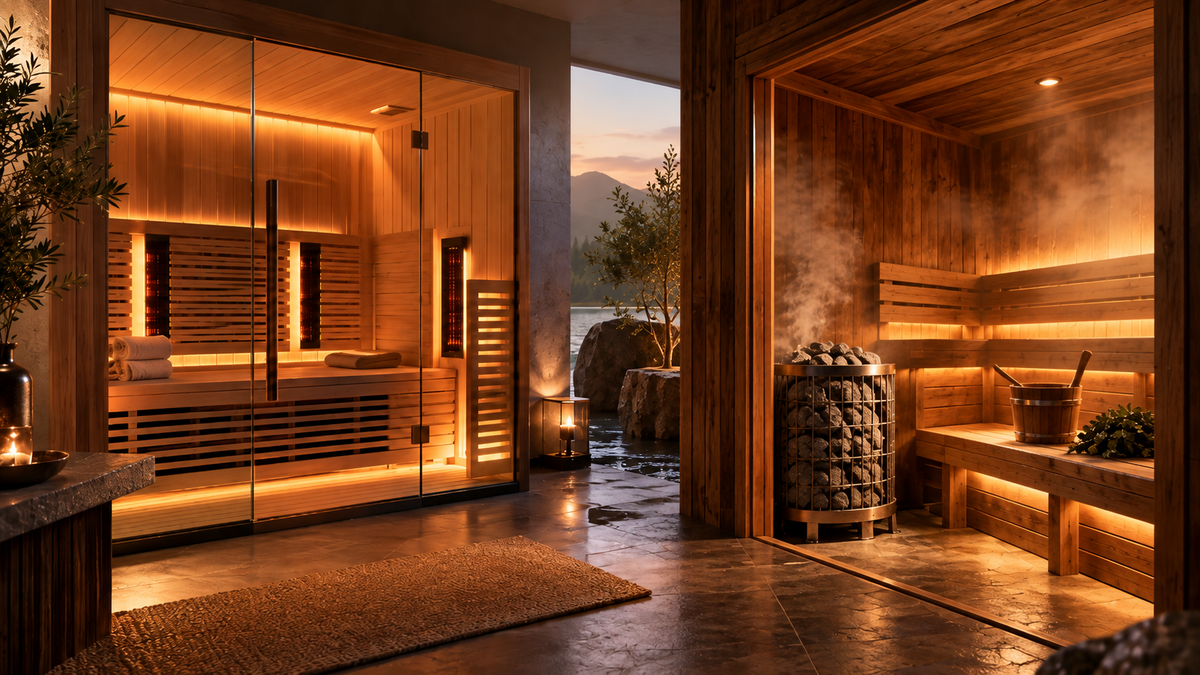
Infrared and traditional saunas both use heat, but they create that heat in very different ways. Traditional saunas primarily heat the air around you, while infrared saunas use infrared emitters to transfer radiant heat more directly to the body. That difference affects the temperature of the room, the way the heat feels, installation requirements, and the overall sauna experience.
If you are comparing the two for a home recovery space, neither style is automatically better. The better choice depends on how hot you want the room to feel, whether you prefer a classic sauna ritual, how much space and electrical capacity you have, and which features matter most to you.
Quick answer: infrared vs. traditional sauna
| Feature | Infrared Sauna | Traditional Sauna |
|---|---|---|
| How it heats | Infrared emitters provide radiant heat | A heater warms the sauna room and usually heated stones |
| Typical room temperature | Generally lower, often about 110–135°F | Generally higher, often about 150–195°F |
| Humidity | Usually dry | Usually dry, but water can often be added to heated stones for brief increases in humidity |
| Heat sensation | Lower air temperature with radiant warmth | Hotter ambient air and a more intense classic sauna environment |
| Common appeal | People who prefer a lower-temperature experience or a compact home setup | People who want the classic Finnish-style sauna experience |
Temperature ranges vary by model, heater, room size, controls, ventilation, and manufacturer specifications.
What is a traditional sauna?
A traditional sauna uses a heater to raise the temperature of the air inside an enclosed room. Many traditional systems also heat a bed of stones. Depending on the heater and manufacturer instructions, users can often pour a small amount of water over the stones to create a temporary burst of humidity.
Traditional Finnish-style saunas are commonly operated at relatively high temperatures. Research describing Finnish sauna bathing often cites temperatures around 80–100°C (176–212°F) with low baseline humidity, although consumer products and personal preferences vary considerably.
The defining feature is the environment: the entire room becomes hot. When you sit inside, your body warms largely because of the high ambient temperature and heat radiating from the heater and surrounding surfaces.
What is an infrared sauna?
An infrared sauna uses infrared emitters or panels rather than relying primarily on extremely hot room air. Those emitters produce infrared radiation that transfers energy as heat to the body and nearby surfaces.
Because the heating approach is different, infrared cabins generally operate at lower room temperatures than traditional Finnish-style saunas. Cleveland Clinic notes that infrared saunas commonly operate around 110–135°F, compared with roughly 150–195°F for many traditional saunas.
You may also see infrared saunas described as far infrared or full spectrum. Those labels refer to the infrared wavelengths used by the system. They should not be treated as proof that one sauna produces a particular medical outcome; the quality of the equipment, heat distribution, controls, materials, and your preferred experience still matter.
How does the experience feel different?
Traditional sauna: hotter air and a classic sauna ritual
If you like entering a room that immediately feels intensely hot, traditional sauna is usually the closer match. The elevated air temperature is central to the experience. In compatible systems, adding water to the stones can briefly increase perceived heat and humidity.
Traditional sauna also offers the experience many people associate with Finnish sauna culture: hot room, heated stones, cooling-off periods, and repeated rounds according to personal preference.
Infrared sauna: lower air temperature and radiant warmth
Infrared cabins generally feel less punishing in terms of ambient air temperature. Some users prefer that because they can tolerate the environment more comfortably while still becoming warm and sweating.
That does not mean an infrared sauna is “mild.” It is still a heat exposure environment, and hydration, session length, and personal heat tolerance still matter.
Which sauna gets hotter?
Traditional saunas generally reach higher air temperatures. In clinical and review literature, Finnish-style saunas are commonly described in the 80–100°C range, while infrared sauna interventions have typically used lower temperatures.
That higher thermometer reading does not automatically make traditional sauna better, and the lower infrared temperature does not automatically make infrared better. They are simply different methods of creating a heat experience.
Do infrared and traditional saunas have different health benefits?
This is one of the most important places to separate evidence from marketing.
Sauna bathing has been studied for cardiovascular, relaxation, pain, exercise-recovery, and other outcomes, but the strength of the research is not equal across every sauna type or every claimed benefit. Traditional Finnish sauna has the deepest long-term observational research base. Infrared sauna has also been studied, but many studies are smaller and use specific protocols or patient populations.
A systematic review that included both Finnish-style and infrared sauna research concluded that regular dry sauna bathing may have potential health benefits, while also noting that the evidence was not strong enough to establish that one sauna type produces distinct health benefits over the other.
For a buyer, that means the more useful question is usually not, “Which one is medically superior?” Instead ask, “Which style am I more likely to use consistently and safely, and which equipment best fits my home?”
What should you compare when buying a home sauna?
1. Heating style
Decide whether you want high-temperature room heat or a lower-temperature infrared experience. This is the biggest experiential difference between the two categories.
2. Electrical requirements
Do not assume every sauna plugs into the same outlet. Electrical requirements vary substantially by size, heater output, voltage, and model. Some compact infrared units may use relatively simple connections, while larger cabins and many traditional heaters require dedicated electrical service. Always follow the manufacturer's specifications and use a qualified electrician where required.
3. Room size and capacity
A one- or two-person sauna behaves very differently from a larger four- or six-person cabin. Consider not only the stated person capacity but also interior bench dimensions, ceiling height, heater sizing, and the amount of usable sitting or lying space.
4. Materials and construction
Wood species, wall construction, insulation, glass area, hardware, and fit-and-finish can affect durability, heat retention, appearance, and price. When comparing expensive units, look beyond the marketing name and inspect the actual construction specifications.
5. Heater and control system
For traditional saunas, heater sizing and controls are major purchase considerations. For infrared saunas, look at panel placement, temperature controls, available zones, and the manufacturer's description of the emitter system.
6. EMF specifications
Some infrared manufacturers advertise “low EMF,” “near-zero EMF,” or similar measurements. Those terms are not especially useful unless you also know how the measurement was taken. If EMF is important to you, compare the measurement distance, testing method, frequency range, and whether the manufacturer provides actual test data instead of relying only on a marketing label.
7. Installation and location
Think about where the sauna will live before choosing a model. Indoor versus outdoor placement, flooring, ceiling clearance, access for delivery, electrical routing, ventilation, and local code requirements may narrow your options quickly.
8. Warranty and long-term support
High-ticket recovery equipment should be evaluated as a long-term purchase. Compare coverage on the cabin, heater or infrared panels, controls, electronics, and labor. Also check who handles replacement parts and technical support after the sale.
How these differences show up in actual Recovery Legacy sauna models
Category descriptions become much more useful when you compare real equipment. A few Golden Designs models in the Recovery Legacy catalog show how infrared, traditional and hybrid heating can change the electrical requirements, form factor and installation plan.
| Model | Heating system | Capacity | Electrical | Notable specification |
|---|---|---|---|---|
| Golden Designs Full Spectrum Infrared Sauna with Himalayan Salt Bar | Full Spectrum infrared with floor heater | 2 or 3 people | 2-person: 1600W, 120V / 15A dedicated circuit 3-person: 2200W, 120V / 20A dedicated circuit |
Listed Full Spectrum EMF specification: 0 mG at 3 inches / 1 mG at 1 inch |
| Golden Designs Arlberg 3 Person Outdoor Traditional Sauna | Traditional 8kW Harvia stove | 3 people | 240V / 40A | Canadian hemlock construction with an outdoor waterproof clear finish |
| Golden Designs Carinthia 3 Person Outdoor Hybrid Sauna | Full Spectrum infrared + traditional 8kW Harvia stove | 3 people | 240V / 40A | Combines infrared heating and a traditional sauna stove in the same outdoor cabin |
This comparison illustrates why the words infrared and traditional only tell part of the story. In these specific models, the two- and three-person infrared sauna uses a dedicated 120V circuit, while the Arlberg traditional sauna uses a 240V / 40A connection for its 8kW Harvia stove. That difference can materially affect where the sauna can be installed and what electrical work may be required.
The Carinthia is also a useful reminder that the choice is not always binary. Its hybrid design combines Full Spectrum infrared heating with an 8kW traditional Harvia stove. For buyers who value both experiences, a hybrid sauna may be worth comparing alongside dedicated infrared and traditional models.
Capacity and construction can change the equation again. For example, the Golden Designs Bergen is designed for four to six people, uses an 8kW Harvia stove and a 240V / 40A electrical connection, and pairs a red cedar interior with an all-weather exterior. The practical takeaway is to compare the actual heater, electrical requirements, dimensions and materials of the model you are considering rather than assuming every sauna in a category installs or performs the same way.
Specifications above reflect the product information currently listed by Recovery Legacy and may change. Always confirm the final manufacturer specifications and electrical requirements for the exact model before installation.
Who may prefer an infrared sauna?
An infrared sauna may be a better fit if you:
- Prefer lower room temperatures.
- Want a compact sauna for a home gym, bedroom suite, basement, or recovery room.
- Like radiant heat more than extremely hot ambient air.
- Are interested in features commonly found on infrared cabins, such as zoned emitters, lighting, audio, or digital controls.
- Want to compare panel placement, infrared spectrum, and EMF testing as part of the purchase decision.
Who may prefer a traditional sauna?
A traditional sauna may be a better fit if you:
- Want the classic high-heat sauna experience.
- Prefer heated stones and the option, when permitted by the heater manufacturer, to introduce brief humidity with water.
- Want a larger sauna room or an outdoor/barrel-style setup.
- Value the ritual and feel of Finnish-style sauna bathing.
- Want to select the heater separately from the sauna structure.
Infrared vs. traditional sauna: which should you buy?
Choose based on the experience you will actually enjoy using.
Choose infrared if you want a lower-temperature cabin with radiant heat and you prefer the features and form factors commonly offered by infrared manufacturers.
Choose traditional if you want hotter room air, heated stones, and the classic sauna experience.
For a high-ticket purchase, we recommend comparing specific models rather than choosing solely by sauna category. A well-built traditional sauna and a well-built infrared sauna can both be excellent products, but installation requirements, materials, heater output, controls, warranty terms, and cabin dimensions can matter more than a broad label.
Frequently asked questions
Is an infrared sauna the same as a traditional sauna?
No. Both create heat exposure, but infrared saunas use infrared emitters, while traditional saunas primarily heat the room air using a sauna heater.
Which sauna is hotter?
Traditional saunas generally operate at higher air temperatures than infrared saunas.
Can you pour water inside an infrared sauna?
Do not pour water on infrared emitters or equipment unless the manufacturer specifically states that the system is designed for it. Infrared cabins are generally used as dry environments.
Is infrared sauna healthier than traditional sauna?
Current evidence does not establish that infrared sauna is universally healthier than traditional sauna. Research supports studying sauna and passive heat exposure more broadly, but direct evidence proving one type is medically superior remains limited.
Which type is easier to install?
It depends on the model. Some compact infrared cabins can be relatively straightforward, while larger infrared systems and traditional saunas may require dedicated circuits, professional electrical work, ventilation planning, or additional construction.
Does a traditional sauna have to be wood-burning?
No. Traditional sauna heaters can be wood-burning, electric, and in some applications gas-powered. Electric heaters are common in residential installations.
Safety note
Saunas expose the body to significant heat. Dehydration, light-headedness, heat intolerance, and drops in blood pressure can occur. Avoid alcohol during sauna use, stay hydrated, and leave the sauna if you feel dizzy, faint, or unwell. People who are pregnant, have cardiovascular conditions, take medications that affect blood pressure or hydration, or have concerns about heat exposure should discuss sauna use with a qualified healthcare professional.
Sources and further reading
- Clinical Effects of Regular Dry Sauna Bathing: A Systematic Review
- The Multifaceted Benefits of Passive Heat Therapies: A Review With a Focus on Finnish Sauna
- Cleveland Clinic: Infrared Saunas
Ready to compare equipment?
Recovery Legacy educational content is provided for general informational purposes and is not medical advice. Product specifications and installation requirements vary by manufacturer and model.

Leave a comment
This site is protected by hCaptcha and the hCaptcha Privacy Policy and Terms of Service apply.